Forestry Mulching vs. Traditional Land Clearing: Which Is Right for Your Northwest Florida Property?
If you own overgrown land around Milton, Pace, Pensacola or anywhere in the Panhandle, you’ve probably heard both terms — forestry mulching and land clearing — used like they’re the same thing. They’re not. They solve different problems, they leave behind very different ground, and picking the wrong one either wastes money or leaves you with land that can’t do what you bought it to do.
Here’s the straight version of how we explain it to property owners every week.
What forestry mulching actually is
Forestry mulching is one machine doing the whole job: a skid steer running a mulcher head — a drum of carbide teeth — that grinds standing brush, palmetto, vines and small trees into wood chips right where they grow. There’s no cutting crew ahead of it and no cleanup crew behind it. What stood in the way in the morning is a layer of mulch on the ground by the afternoon.
Three things make that a big deal on Panhandle land:
- Nothing leaves the property. No burn piles smoldering for a week, no dump trucks, no debris fees. The material becomes ground cover.
- The soil stays put. The work happens above the dirt. Roots stay in the ground and keep our sandy soil from washing out in the first summer thunderstorm.
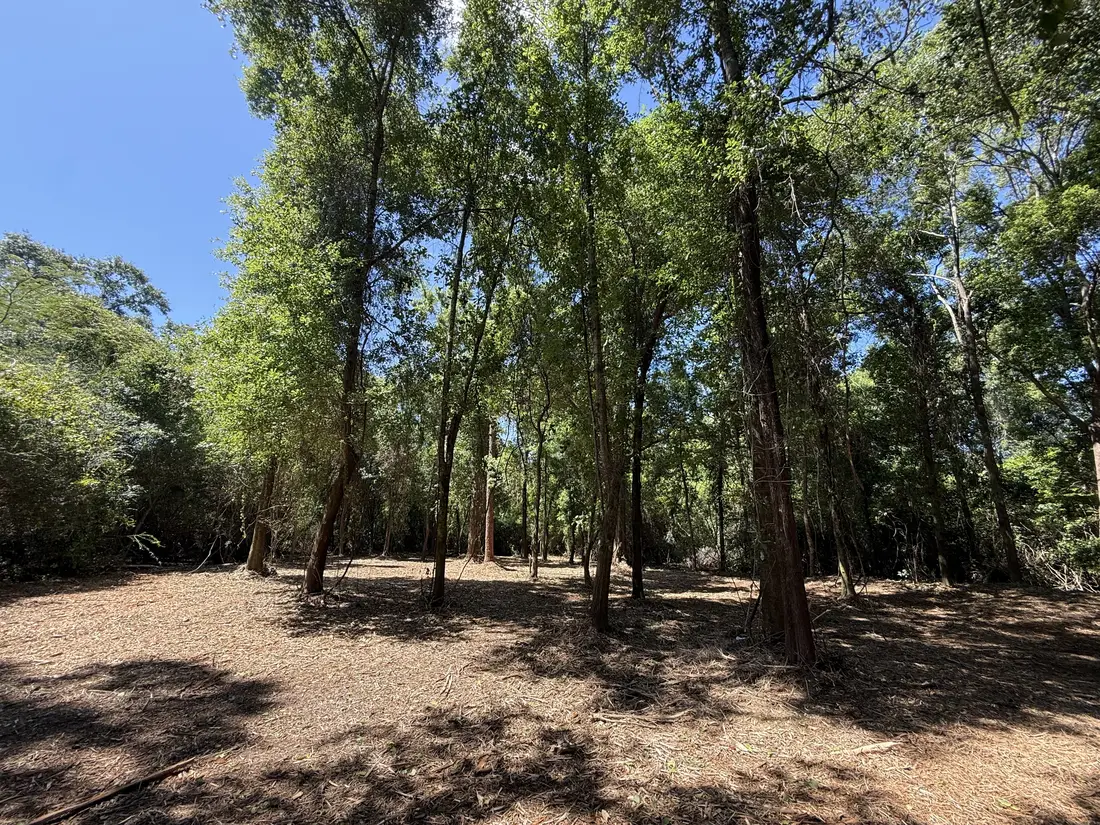
- It’s selective. The operator works around every tree you want to keep. You can take a choked-out ten acres and turn it into open, park-like woods — mature pines and live oaks standing, everything between them gone.
In typical growth, a mulcher covers roughly an acre a day. That number moves with how thick and woody the property is, but it’s the honest planning frame.
What traditional land clearing actually is
Traditional land clearing changes the ground itself. Trees come down and come out — root balls and all — using excavators, root grapples and skid steers. Debris gets stacked, processed or hauled. What’s left isn’t a mulched forest floor; it’s workable dirt.
That’s more machine time, more handling, and usually more cost. And sometimes it’s exactly right, because mulching has a hard limit: it leaves the roots and organics in the soil. Anything you build on top of buried organic material is building on something that will rot, settle and move.
So when the plan involves construction, the footprint needs real clearing:
- House pads, barns, garages, sheds
- Driveways and anything that carries vehicle weight
- Septic areas and utility runs
- Any spot where you need clean, gradeable dirt
The quick decision table
| Your goal | The right method |
|---|---|
| Usable, walkable, park-like land | Forestry mulching |
| Hunting trails, food plots, shooting lanes | Forestry mulching |
| Fence lines opened and maintained | Forestry mulching |
| Pasture reclaim from brush | Mulching, then regular cutting |
| House pad, barn pad, new building | Traditional clearing |
| New driveway or access road | Traditional clearing + grading |
| Lot cleared for sale listing | Usually mulching — cheaper, looks better |
| Firebreaks around structures or timber | Mulching |
Why most Panhandle jobs end up being both
Here’s the part the either/or framing misses: most real properties need a mix.
The classic example is a wooded parcel with a build coming. The house pad, the septic area and the driveway corridor get traditionally cleared and grubbed — roots out, dirt honest, ready for the contractor. The other 80% of the parcel gets mulched: opened up, made walkable, keeper trees standing, finished ground that doesn’t erode. The full homesite sequence is in our guide to clearing land to build a house.
Doing it that way costs a fraction of clear-cutting the whole property, and the finished result looks better — the house sits in woods instead of in a scrape. It’s also why hiring one crew that runs both kinds of equipment matters: the mulcher, the grapple and the mini excavator show up on the same mobilization, and the property gets the right treatment zone by zone instead of one blunt method everywhere.
What about regrowth?
This is Florida — everything grows back. The difference is speed and effort.
A mulched property fights regrowth two ways: the cut takes years of growth down to ground level, and the mulch layer shades the soil so the seed bank underneath germinates slower. A bulldozed property does the opposite — bare, disturbed sand is an open invitation, and the first things back are usually the weeds and scrub you paid to remove.
Either way, the win is maintenance: a light brush hogging pass every so often keeps opened land open for a small fraction of the original cost. Land care here isn’t a one-time event; it’s a rhythm — but the rhythm is cheap once the hard work is done.
What it costs — and why nobody honest quotes blind
Both methods price off the same variables: acreage, growth density, terrain, access, and what the finished ground needs to be. Mulching is usually the cheaper path on brush and small trees because it’s one machine and no haul-off; clearing costs more because it moves more material and changes the dirt. Real per-acre ranges for both are in our land clearing cost guide.
Anyone who gives you a firm number over the phone without seeing the property is guessing — and you’ll find out whose problem that guess becomes when the machines show up. We walk the land with you, flag what stays and what goes, and hand you a free estimate with a straight number and a real timeline.
If you’re looking at a wall of green and trying to picture usable land, that walk-through is the place to start. Call (850) 910-2447 — Clearview Contracting Solutions, based in Jay, working all of Northwest Florida.